




























Asia-Pacific Exosome Research Products Market: Unlocking the Future of Cellular Communication
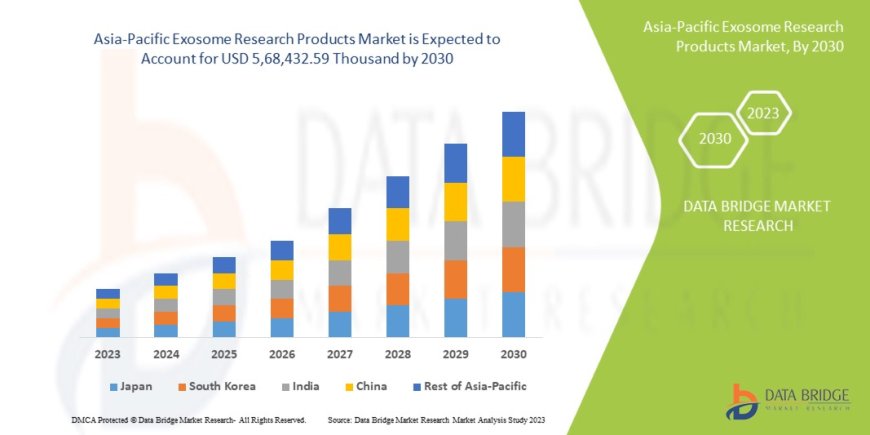
Data Bridge Market Research analyzes that the Asia-Pacific exosome research products market is expected to reach the value of USD 5,68,432.59 thousand by 2030, at a CAGR of 40.3% during the forecast period.

Introduction
Exosomes are small extracellular vesicles that play a critical role in intercellular communication. They carry biomolecules such as RNA, DNA, lipids, and proteins between cells, influencing various physiological and pathological processes. In recent years, the field of exosome research has gained significant traction in the Asia-Pacific region, driven by its potential applications in diagnostics, therapeutics, and drug delivery.
The Asia-Pacific exosome research products market is expanding rapidly due to increased research activities, academic collaborations, government funding, and biotechnology investments. Exosome research is paving the way for breakthroughs in oncology, neurology, cardiology, and infectious diseases, positioning the region as a key player in the global biotech innovation landscape.
Source:https://www.databridgemarketresearch.com/reports/asia-pacific-exosome-research-products-market
The Evolution
The discovery of exosomes dates back to the 1980s when they were initially thought to be waste vesicles expelled by cells. However, with the advancement of molecular biology techniques, their role in intercellular communication and disease mechanisms was discovered, transforming them into a research hot spot.
By the early 2000s, studies revealed exosomes could transfer functional genetic material between cells. This shifted their status from cellular debris to critical players in cell signaling. Researchers started developing protocols to isolate, characterize, and study exosomes more systematically.
In the Asia-Pacific region, countries like China, Japan, South Korea, India, and Australia began investing in exosome-related projects, leading to the formation of dedicated research labs and biotech startups. By the mid-2010s, commercial kits, reagents, and instruments for exosome research became widely available.
Today, exosome research products include isolation kits, labeling and detection reagents, purification tools, analysis instruments, and exosome-specific antibodies. Academic institutions and biopharma companies across Asia-Pacific are actively exploring their diagnostic potential and as vehicles for targeted drug delivery.
Market Trends
Increased Government and Institutional Funding: Governments across the Asia-Pacific region are funding life science research, especially in precision medicine and liquid biopsy, where exosomes play a crucial role.
Rise of Exosome-Based Diagnostics: Diagnostic companies are developing blood-based tests that use exosomal biomarkers to detect cancer, neurological disorders, and infectious diseases at early stages.
Adoption of Advanced Isolation Technologies: Innovations in ultracentrifugation, immunoaffinity capture, microfluidics, and size-exclusion chromatography are enhancing the purity and yield of exosomes.
Surge in Personalized Medicine Research: Exosomes are being used to identify patient-specific biomarkers, aiding in tailored treatment plans for cancer and rare genetic conditions.
Collaborations and Mergers: Academic-industry collaborations are driving innovation. Biotech companies are partnering with universities for the development and commercialization of novel exosome tools.
Integration with Nanotechnology: Exosomes are being engineered and loaded with nanomaterials for targeted therapy, especially in cancer treatment and regenerative medicine.
Expansion of Clinical Trials: Many clinical trials using exosome-based delivery systems or diagnostics are being initiated or expanded in Asia-Pacific, increasing demand for research-grade exosome products.
Proliferation of Exosome Biobanks: Institutions are establishing exosome sample repositories to support large-scale genomic and proteomic studies, accelerating product development.
Adoption of Automation and AI: AI algorithms are being used to analyze exosome data for disease prediction and drug response modeling, while automation tools streamline the isolation and analysis process.
Growing Popularity of Exosome-Based Cosmeceuticals: In countries like South Korea and Japan, exosome-derived products are entering the skincare market due to their regenerative properties.
Challenges
Lack of Standardization: The field lacks uniform standards for exosome isolation, quantification, and characterization, which limits reproducibility and comparability of research results.
High Cost of Equipment: Exosome research requires sophisticated equipment like ultracentrifuges, NTA instruments, and electron microscopes, which can be prohibitively expensive for small labs.
Complexity of Isolation Methods: Despite technological improvements, many isolation protocols are time-consuming, require skilled operators, and can result in contamination with other vesicles.
Regulatory Uncertainty: With exosomes being explored for therapeutic applications, unclear regulatory frameworks can delay product approvals and commercialization.
Limited Awareness Among Researchers: In several parts of the Asia-Pacific region, especially in developing countries, there is limited knowledge about exosome research tools and their potential applications.
Short Shelf Life of Products: Many reagents and kits used in exosome research have limited shelf lives, requiring careful storage and handling, which poses logistical challenges.
Lack of Skilled Workforce: The rapid advancement in exosome technologies is not matched by sufficient training programs, creating a skills gap in both academic and commercial sectors.
Intellectual Property Issues: As the field is still maturing, IP disputes regarding isolation methods and therapeutic use of exosomes are becoming more common.
Data Interpretation Difficulties: High-dimensional omics data derived from exosomes require advanced computational tools and expertise, which are not universally available.
Ethical Concerns: The use of exosomes derived from human tissues (e.g., placental exosomes) for commercial use raises ethical concerns that need to be addressed through clear guidelines.
Market Scope
By Product Type
-
Kits & Reagents
-
Instruments
-
Software & Services
By Application
-
Cancer Research
-
Neurological Disorders
-
Cardiovascular Diseases
-
Infectious Diseases
-
Stem Cell Research
-
Drug Delivery Studies
By Workflow
-
Isolation & Purification
-
Detection & Analysis
-
Labeling & Tracking
-
Quantification
By End User
-
Academic & Research Institutes
-
Pharmaceutical & Biotechnology Companies
-
Hospitals & Clinical Testing Labs
-
Contract Research Organizations (CROs)
By Region (Asia-Pacific)
-
China
-
Japan
-
South Korea
-
India
-
Australia
-
Southeast Asia
-
Rest of Asia-Pacific
Market Size
The Asia-Pacific exosome research products market was valued at USD 120 million in 2024 and is projected to reach USD 410 million by 2030, growing at a CAGR of 18.9% during the forecast period. China and Japan are currently the dominant players due to their robust biotech ecosystems and government backing. South Korea is emerging as a leader in exosome-based cosmeceutical research, while India is experiencing strong growth in academic exosome research.
Kits and reagents account for the largest revenue share due to their consumable nature and widespread use in daily research workflows. However, demand for analytical instruments like NTA (Nanoparticle Tracking Analysis), flow cytometers, and TEMs is also growing due to the need for high-precision analysis.
Cancer research is the largest application segment, with neurological disorders and regenerative medicine expected to see rapid growth due to recent breakthroughs in exosome signaling and therapy.
Online distribution channels for exosome research products are expanding in the region, especially in urban research clusters, supported by scientific supply portals and university procurement systems.
Factors Driving Growth
Growing Cancer Burden: The high incidence of cancer across Asia-Pacific is driving research into exosome-based liquid biopsies and therapeutic delivery systems, increasing demand for research-grade products.
Expansion of Biotechnology Hubs: Countries like China, India, and Singapore are investing in biotechnology parks, startup incubators, and academic R&D zones that facilitate exosome research.
Rise of Precision Medicine Initiatives: Government programs are focusing on personalized healthcare, which relies on molecular dataan area where exosomes serve as rich biomarker sources.
High Throughput Genomic and Proteomic Technologies: Advancements in NGS, mass spectrometry, and bioinformatics allow detailed analysis of exosomal content, propelling research utility.
Global Collaborations: Asia-Pacific research institutions are participating in international consortiums and publishing collaborative studies that increase visibility and research funding.
Surge in Venture Capital Investments: Startups focused on exosome diagnostics and drug delivery are attracting VC funding, which accelerates product innovation and commercialization.
Digitalization and AI Integration: Use of AI in exosome data analytics is growing, facilitating biomarker discovery, disease classification, and identification of therapeutic targets.
Cost Efficiency of Exosome Therapies: Compared to cell-based therapies, exosome-based approaches are less expensive, scalable, and potentially safer, making them more attractive to researchers.
Cosmeceutical Demand: The beauty and wellness industry in Asia-Pacific is exploring the use of exosomes for anti-aging, wound healing, and skin regeneration, expanding the research scope.
Academic Excellence and Infrastructure: Leading universities and research institutes across the region are investing in exosome-specific labs and programs, creating a strong knowledge base and talent pool.